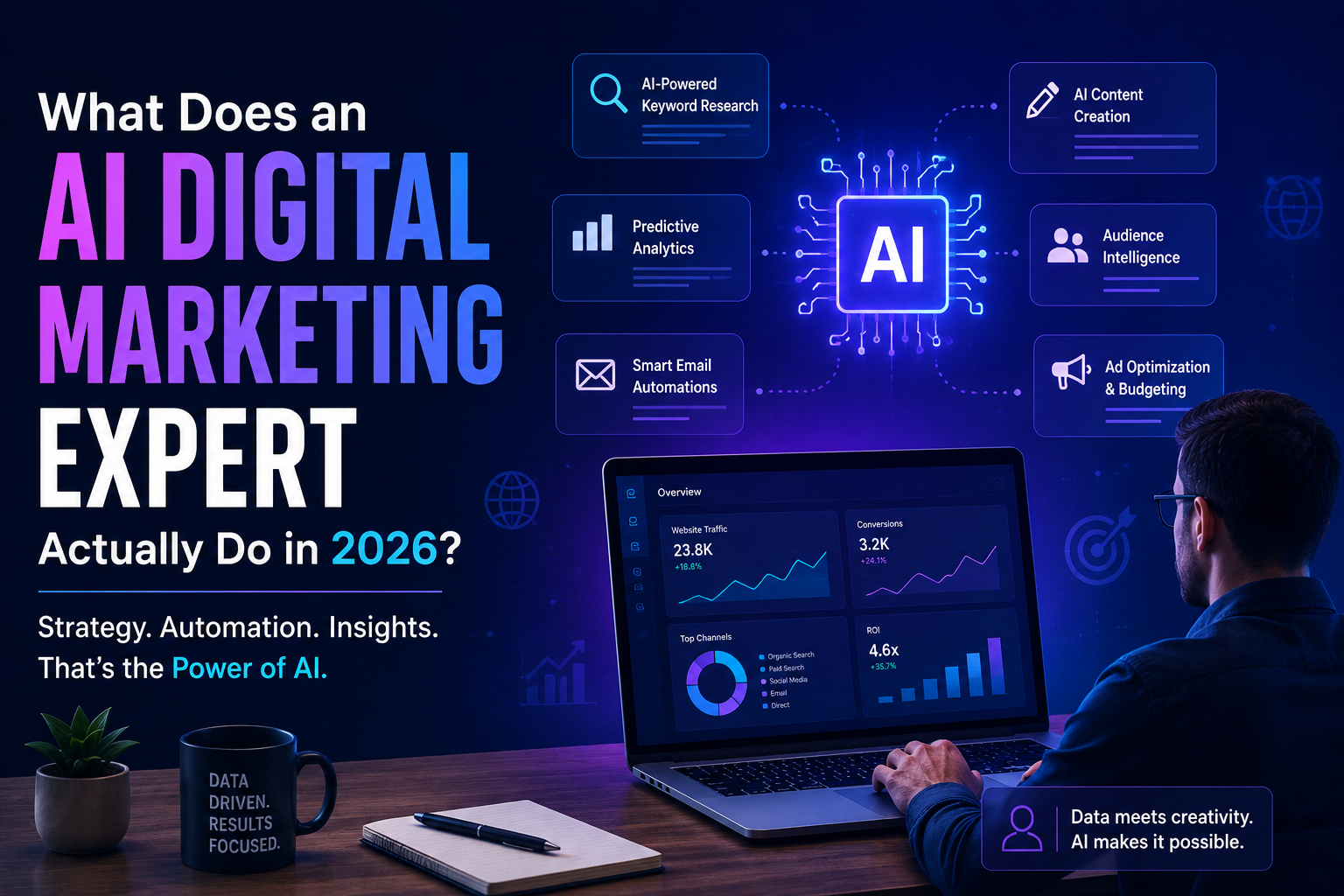
What Does an AI Digital Marketing Expert Actually Do in 2026?
Introduction
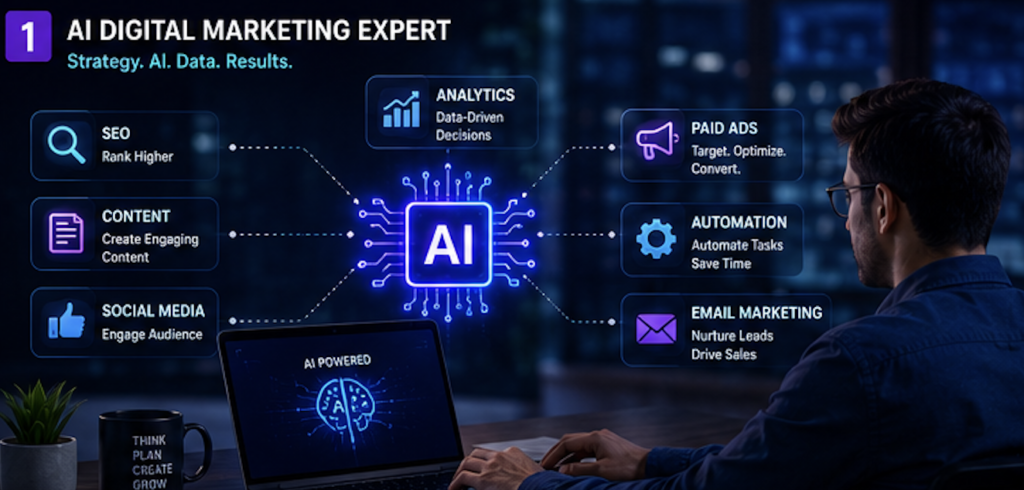
Artificial intelligence has changed digital marketing.
A few years ago, digital marketers primarily focused on SEO, social media, Google Ads, email marketing, content, and analytics.
In 2026, those skills are still important, but the way marketers use them is changing.
Today, an AI digital marketing expert doesn’t simply know how to use AI to write a blog post.
They understand how to combine AI, marketing strategy, customer data, automation, search, content, and performance analytics to help a business attract and convert customers.
So what does an AI digital marketing expert actually do?
Let’s break it down.
What Is an AI Digital Marketing Expert?
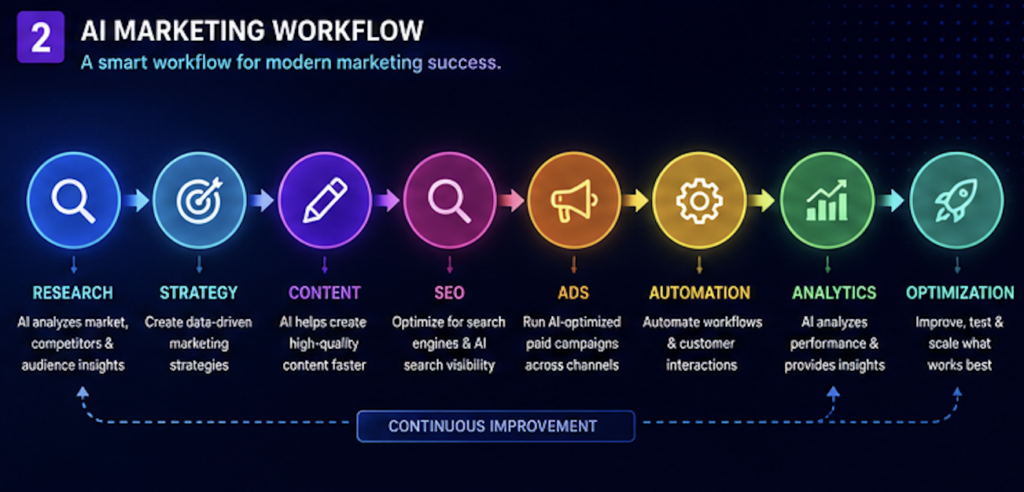
An AI digital marketing expert is a marketer who uses artificial intelligence to improve the planning, execution, automation, personalization, and measurement of digital marketing campaigns.
Think of the role as a combination of:
Digital Marketer + AI Strategist + Data Analyst + Automation Specialist
The goal isn’t to use AI everywhere.
The goal is to identify where AI can make marketing faster, smarter, more personalized, and more measurable.
1. Develops AI-Powered Marketing Strategies
Before launching campaigns, an AI digital marketing expert needs to understand the business.
They look at:
- Target audience
- Customer problems
- Competitors
- Marketing channels
- Existing traffic
- Conversion rates
- Customer journeys
- Business goals
- Available budget
AI can help analyze large amounts of information and identify patterns, but the marketer still needs to decide what the business should actually do.
For example, an AI tool might identify that a particular customer segment is highly engaged with video content.
The marketer’s job is to turn that insight into a strategy.
2. Uses AI for Customer and Market Research
Market research is one of the areas where AI can save significant time.
An AI digital marketing expert can use AI to organize customer feedback, identify recurring questions, analyze reviews, study competitors, and develop customer personas.
Instead of simply asking:
“Who are my customers?”
The marketer can investigate:
- What problems do customers have?
- What words do they use?
- What objections stop them from buying?
- What alternatives are they considering?
- What information do they search for?
- What motivates them to take action?
These insights can influence everything from website copy to advertising campaigns.
3. Creates and Repurposes Content With AI
Content remains a major part of digital marketing.
But creating content consistently can take a lot of time.
AI can help marketers create:
- Blog outlines
- Articles
- Social media posts
- Email campaigns
- Video scripts
- Ad copy
- Landing page copy
- FAQs
- Content calendars
The important difference is that an AI digital marketing expert doesn’t simply copy and paste AI-generated content.
They provide context, refine the messaging, check accuracy, add expertise, and make sure the final content fits the brand.
The marketer becomes more of an editor and strategist, rather than spending all their time starting from a blank page.
4. Optimizes SEO and AI Search Visibility
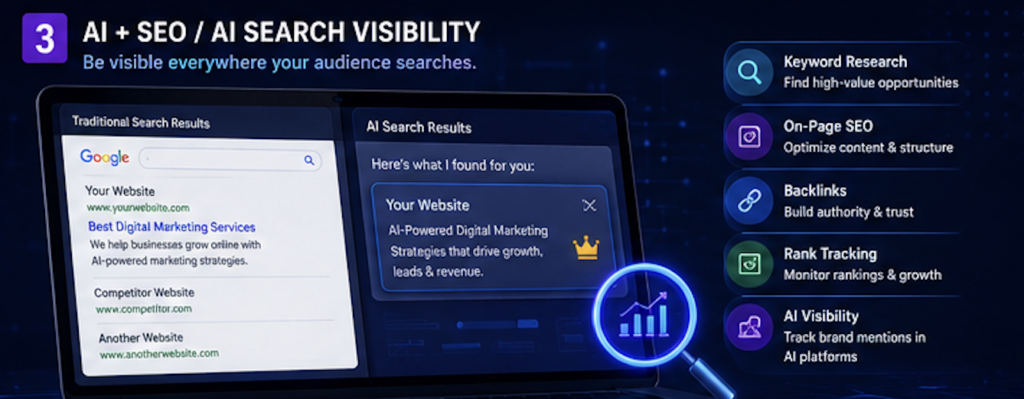
SEO has evolved significantly.
Traditional SEO focuses on helping websites appear in search engine results.
But in 2026, marketers also need to consider how brands appear in AI-generated answers and AI-powered search experiences.
Platforms such as Semrush now provide AI visibility capabilities that allow marketers to monitor how brands are mentioned across AI platforms and compare visibility with competitors.
An AI digital marketing expert may work on:
- Keyword research
- Search intent
- Content structure
- Technical SEO
- Internal linking
- Topic clusters
- Competitor analysis
- AI search visibility
- Content optimization
The objective is simple:
Be visible wherever potential customers are searching.
5. Uses AI to Improve Paid Advertising
Paid advertising can become expensive when campaigns aren’t properly optimized.
AI is increasingly being integrated into advertising platforms to help marketers with campaign creation, targeting, optimization, and performance analysis.
An AI-focused marketer doesn’t simply launch an advertisement and wait for results.
They analyze:
- Cost per click
- Conversion rate
- Cost per acquisition
- Return on ad spend
- Audience performance
- Creative performance
- Landing page performance
AI can help identify patterns and opportunities, while the marketer decides which changes make business sense.
6. Automates Repetitive Marketing Tasks
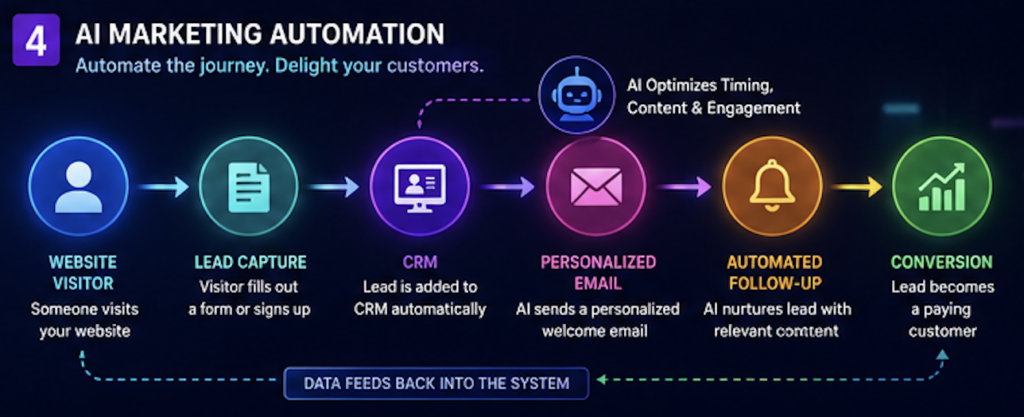
One of the biggest benefits of AI is automation.
An AI digital marketing expert looks for repetitive tasks that don’t necessarily require manual work.
For example:
Lead comes in → CRM records lead → Lead receives personalized email → Sales team receives notification → Follow-up is scheduled
Instead of someone manually managing every step, automation can handle much of the workflow.
HubSpot’s Breeze platform, for example, is designed to support AI-assisted tasks, content creation, information retrieval, and workflow automation across its platform.
The marketer’s role is to design, monitor, and improve these workflows.
7. Personalizes Customer Experiences
Customers don’t all behave the same way.
Someone visiting a website for the first time has different needs from someone who has already purchased a product.
AI allows marketers to analyze customer behavior and create more relevant experiences.
For example:
New visitor
Show educational content.
Returning visitor
Show relevant products or services.
Existing customer
Recommend related products or offer helpful information.
Inactive customer
Send a re-engagement campaign.
This type of personalization can make marketing communication more relevant without requiring marketers to manually create every interaction.
8. Uses AI for Email Marketing
Email marketing is another area where AI can improve efficiency.
AI-powered email platforms can help marketers create content, personalize campaigns, optimize timing, and automate customer journeys.
Mailchimp, for example, offers AI capabilities for email content creation, automated journeys, personalization, analytics, and send-time optimization.
An AI digital marketing expert might create workflows such as:
Website visitor → Newsletter signup → Welcome email → Educational content → Product email → Follow-up
This turns email marketing from a one-time activity into an automated customer journey.
9. Analyzes Marketing Data
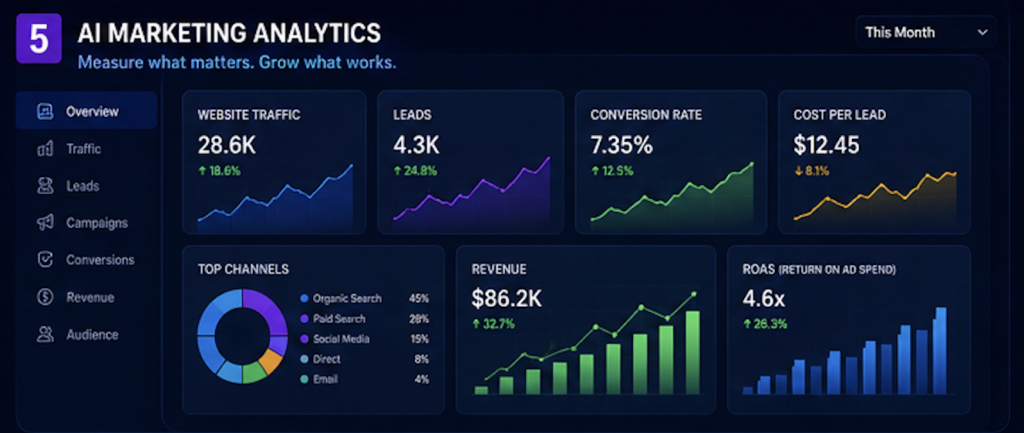
Marketing isn’t just about creating campaigns.
It’s about understanding whether those campaigns actually work.
An AI digital marketing expert monitors metrics such as:
- Website traffic
- Leads
- Conversion rate
- Cost per lead
- Customer acquisition cost
- Revenue
- Return on ad spend
- Email engagement
- Organic traffic
- Search visibility
AI can help marketers identify patterns in large datasets and surface insights faster.
But the marketer still needs to ask the most important question:
“What should we do about this data?”
That’s where strategic thinking becomes important.
10. Tests and Improves Campaigns
Great marketers don’t assume their first idea is perfect.
They test.
AI can help generate different:
- Headlines
- Ad copy
- Calls-to-action
- Email subject lines
- Landing page variations
- Audience segments
- Content ideas
The marketer can then compare performance and identify what works best.
This creates a continuous cycle:
Create → Test → Measure → Learn → Improve
Over time, this process can make campaigns more efficient.
11. Protects Brand Quality and Responsible AI Use
Using AI also creates new responsibilities.
An AI digital marketing expert needs to think about:
- Accuracy
- Customer privacy
- Brand consistency
- Copyright
- Data security
- Transparency
- Human review
AI-generated content shouldn’t automatically be considered correct.
The marketer needs to review important claims, verify information, protect sensitive data, and ensure that marketing remains authentic.
AI should support human decision-making not remove it.
What Skills Does an AI Digital Marketing Expert Need?
Someone entering this field should build a combination of marketing and technology skills.
Core Digital Marketing Skills
- SEO
- Google Ads
- Social media marketing
- Email marketing
- Content marketing
- Conversion rate optimization
- Analytics
- Marketing strategy
AI Skills
- Prompt engineering
- AI-assisted content creation
- AI research
- AI workflow automation
- AI-powered analytics
- AI search optimization
- AI tool evaluation
Technical and Analytical Skills
- Google Analytics
- Looker Studio
- Excel
- CRM platforms
- Basic data analysis
- Marketing automation platforms
Human Skills
Don’t overlook these.
The most valuable skills may include:
- Creativity
- Communication
- Critical thinking
- Problem-solving
- Strategic thinking
- Adaptability
AI can generate an answer.
A good marketer knows which answer is worth using.
AI Digital Marketer vs Traditional Digital Marketer
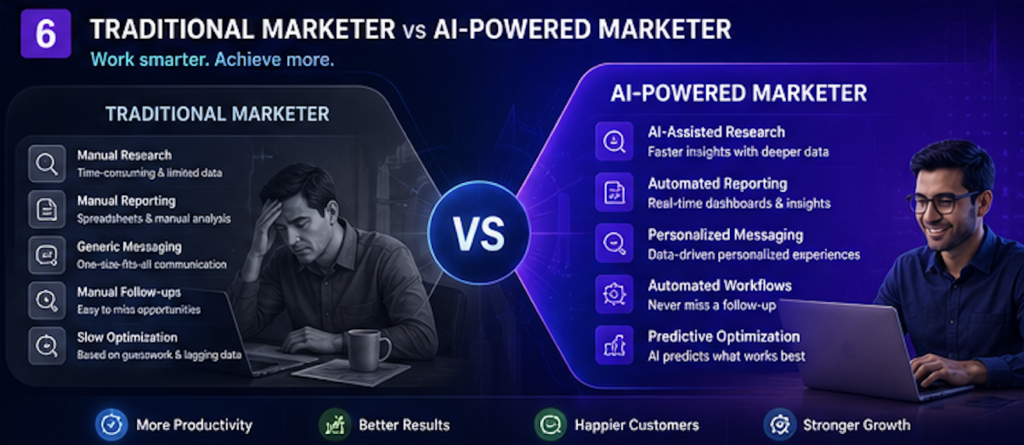
The difference isn’t that one uses AI and the other doesn’t.
The bigger difference is how they approach their work.
| Traditional Approach | AI-Powered Approach |
|---|---|
| Manual research | AI-assisted research |
| Manual content creation | AI-assisted content workflows |
| Manual reporting | Automated reporting and insights |
| Broad messaging | Data-driven personalization |
| Manual follow-ups | Automated customer journeys |
| Traditional SEO | SEO + AI search visibility |
| Manual testing | Faster experimentation |
The future isn’t necessarily about replacing traditional marketing.
It’s about adding AI capabilities to proven marketing fundamentals
Will AI Replace Digital Marketing Experts?
Probably not in the way many people imagine.
AI may automate certain repetitive marketing tasks, but businesses still need people who understand:
customers + strategy + creativity + data + technology.
A business doesn’t need someone who can simply generate 100 social media posts.
It needs someone who can answer:
- Who should we target?
- What should we say?
- Which channel should we use?
- How much should we spend?
- Why isn’t the campaign converting?
- What should we test next?
- How can we turn more leads into customers?
Those are strategic questions.
And that’s why the role of the digital marketer is evolving rather than disappearing
The Future of AI Digital Marketing
AI is changing digital marketing from a collection of manual tasks into increasingly intelligent workflows.
A marketer in 2026 can use AI to research faster, create faster, automate repetitive work, analyze more data, personalize customer experiences, and discover new opportunities.
But technology alone isn’t enough.
The winning combination is:
Marketing knowledge + AI skills + Data + Creativity + Strategy
That’s what makes an AI digital marketing expert valuable.
Final Thoughts
An AI digital marketing expert is not simply someone who knows how to use ChatGPT.
It’s someone who understands how to use AI to solve real marketing problems.
They combine traditional digital marketing knowledge with AI-powered tools to improve everything from customer research and SEO to paid advertising, content creation, automation, personalization, and analytics.
As AI continues to reshape search, advertising, content, and customer experiences, marketers who learn how to work with AI will have a major advantage.
The future of digital marketing isn’t AI versus marketers.
It’s AI-powered marketers.
Frequently Asked Questions
What is an AI digital marketing expert?
An AI digital marketing expert is a marketer who uses artificial intelligence to improve marketing strategy, content creation, SEO, advertising, automation, personalization, and data analysis.
What does an AI digital marketer do?
They use AI to research audiences, create and optimize content, improve SEO, manage campaigns, automate workflows, analyze marketing data, personalize customer experiences, and improve campaign performance.
Is AI digital marketing a good career in 2026?
Yes. As businesses increasingly adopt AI, marketers who combine strong digital marketing fundamentals with AI and analytics skills can work across areas such as performance marketing, SEO, content, marketing automation, and growth marketing.
What AI tools do digital marketers use?
Depending on their responsibilities, marketers may use tools such as ChatGPT for content and research, Canva for visual content, Semrush for SEO and AI visibility, HubSpot for CRM and automation, and Mailchimp for AI-assisted email marketing.
Do I need coding skills to become an AI digital marketing expert?
You don’t necessarily need advanced coding skills. Strong marketing fundamentals, AI literacy, analytics, automation, and the ability to use marketing platforms effectively are more important for most digital marketing roles.
What is the difference between AI marketing and digital marketing?
Digital marketing uses online channels such as search engines, social media, email, websites, and paid advertising. AI marketing adds artificial intelligence to these activities to improve automation, personalization, content creation, analysis, and decision-making.
The future belongs to marketers who don’t just use AI, but know how to use it strategically.
Hi, this is a comment.
To get started with moderating, editing, and deleting comments, please visit the Comments screen in the dashboard.
Commenter avatars come from Gravatar.