SEO vs Social Media: Proven Strategy for Business in 2026
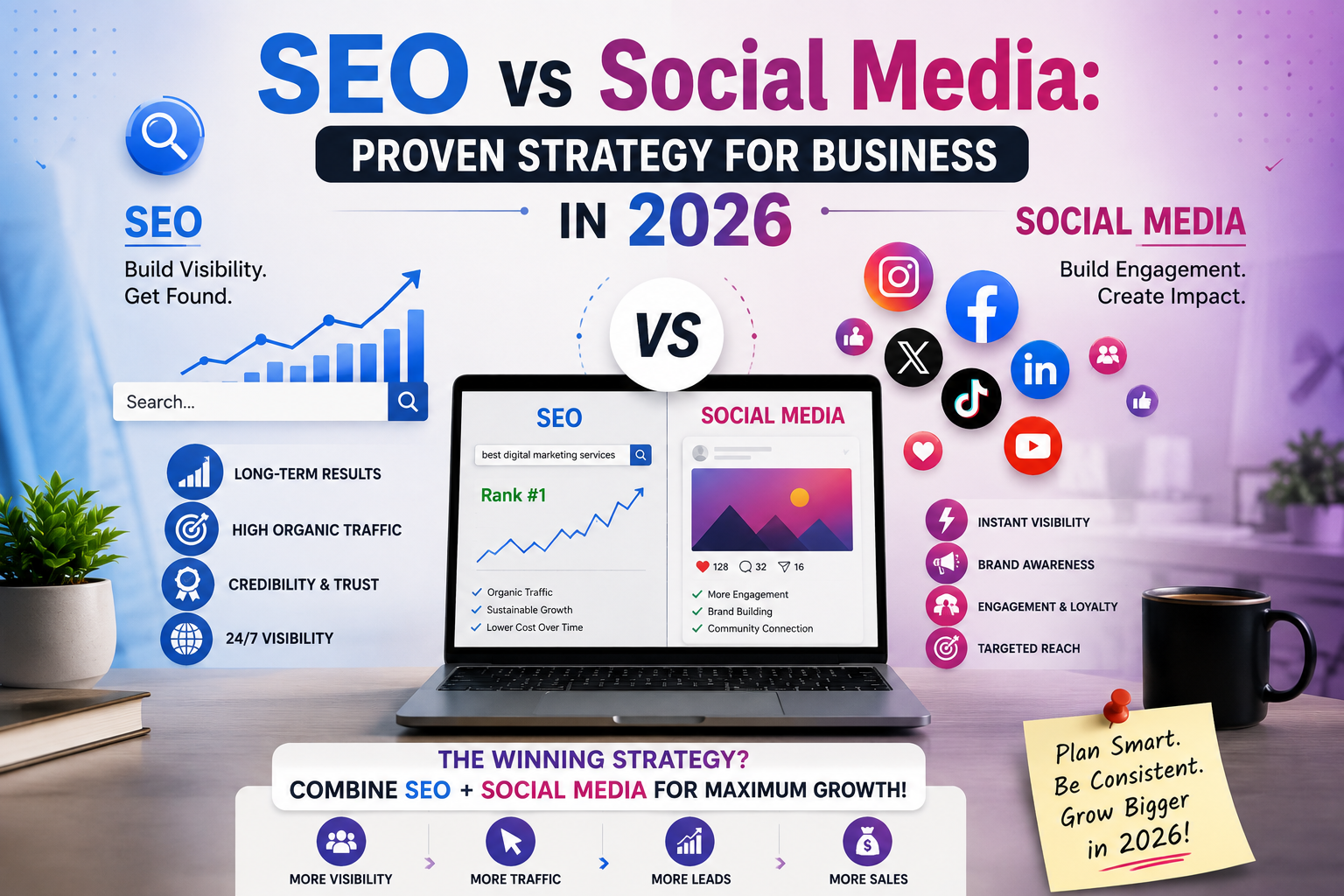
SEO vs social media both different purposes, and neither replaces the other. SEO builds long-term, free traffic by helping your website rank in search results, while social media builds relationships, brand awareness, and quick engagement in real time. Businesses that grow fastest in 2026 use both together: SEO for sustainable, compounding visibility, and social media for immediate connection and trust-building. Choosing one over the other usually means leaving real growth on the table. Many small businesses now work with a digital marketing freelancer in Madhavaram to figure out exactly how to balance both without wasting time or budget on the wrong channel first.
Business owners ask this question constantly: SEO vs social media, which one should we focus on? It sounds like a simple either-or decision, but the real answer is more useful once you understand what each one actually does. They’re not competing for the same job. They’re solving two different problems.
This guide breaks down the SEO vs social media question in detail, covering how each channel works, their real strengths and weaknesses, and how to build a strategy that uses both effectively in 2026.
Why This Question Keeps Coming Up
Marketing budgets are limited, especially for small businesses. When resources are tight, it’s natural to want a single, clear answer to the SEO vs social media debate. Unfortunately, treating SEO and social media as competitors leads many businesses to underinvest in one, only to wonder later why growth stalled.
Understanding the distinct role each channel plays makes it much easier to build a strategy that actually works, instead of guessing.
What Is SEO, and What Does It Actually Do?
SEO, or search engine optimization, is the process of improving your website so it ranks higher in unpaid search engine results. Following best practices recommended by Google Search Central can help businesses make their websites easier for search engines to understand and improve their overall search visibility. When someone searches for a product or service you offer, strong SEO increases your chances of appearing prominently in relevant search results.
The Core Strengths of SEO
- Long-term, compounding traffic. Content that ranks well can keep attracting visitors for months or years without ongoing cost per visitor.
- High buying intent. People searching for a specific product or service are often further along in their decision-making process than someone casually scrolling social media.
- Builds lasting authority. A website that ranks well over time builds credibility that’s difficult for competitors to quickly replicate.
The Real Limitations of SEO
- Slow to show results. Meaningful SEO results typically take three to six months, sometimes longer in competitive industries.
- Requires ongoing maintenance. Search algorithms change, and competitors improve their content, meaning SEO isn’t a one-time task.
- Less effective for real-time engagement. SEO doesn’t offer the immediate, two-way interaction that builds personal connection with an audience.
Social media marketing involves building a presence on platforms where your audience already spends time, sharing useful content, and engaging directly with potential and existing customers. Resources such as Meta for Business can also help businesses understand how social platforms can be used to build awareness, reach audiences, and support their broader marketing strategy.
- Immediate visibility and engagement. A single post can generate interaction within minutes, unlike SEO’s slower timeline.
- Builds personal connection. Direct comments, messages, and behind-the-scenes content create a sense of familiarity that search results alone can’t provide.
- Great for brand awareness. Social media excels at introducing your business to people who weren’t actively searching for you yet, but might become interested through discovery.
- Traffic isn’t guaranteed to last. Algorithm changes can suddenly reduce your reach, even with an engaged following.
- Time-intensive to maintain. Consistent posting, responding, and engaging requires ongoing daily or weekly effort.
- Lower average buying intent. Someone scrolling social media casually is often less ready to purchase than someone actively searching for a solution.
Understanding these core SEO vs social media differences helps clarify why comparing them directly as competitors misses the bigger picture.
Timeline for Results
Social media can generate engagement within hours of posting. SEO typically requires months of consistent effort before showing meaningful ranking improvements and traffic growth.
Cost Structure Over Time
SEO requires upfront investment in time or hiring help, but the cost per visitor drops significantly as content continues ranking without additional spend. Social media, especially paid social advertising, requires ongoing spend to maintain visibility, since organic reach on most platforms has declined significantly over the years.
Type of Audience Intent
SEO traffic often comes from people actively searching for a solution to a specific problem, meaning higher intent to buy or take action. Social media traffic often comes from people casually browsing, meaning lower immediate intent, but higher potential for building brand familiarity over time.
Longevity of Content
A well-ranked blog post or service page can continue generating traffic for years. A social media post typically has a short lifespan, often measured in hours or days, before it’s buried under new content in a follower’s feed.
Control Over Visibility
With SEO, once you rank well, you maintain visibility largely on your own terms, based on your website’s quality and relevance. With social media, an algorithm change beyond your control can dramatically reduce your reach overnight, regardless of your content quality.
Why the Best Strategy Uses Both Together
Rather than treating SEO vs social media as an either-or choice, the most effective approach layers both channels so they support each other.
Sharing a well-optimized blog post or service page on social media can drive initial traffic and engagement, which sometimes indirectly supports SEO performance through increased visibility and potential backlinks from people who discover the content.
Instead of posting generic promotional content, businesses can share genuinely helpful articles and guides built for SEO, giving their social media presence more substance and value, which tends to perform better with audiences.
Someone who’s followed your business on social media for months, seeing real projects and genuine engagement, often searches for your business by name later, combining the trust built through social media with the discovery power of search.
Even the most engaged social media following won’t fully replace the value of appearing in search results when someone is actively, urgently looking for exactly what you offer, often unrelated to your social media presence at all.
How to Decide Where to Focus First
If resources are genuinely limited, prioritizing correctly in the SEO vs social media decision matters more than trying to do everything at once from day one.
Choose SEO First If:
- You have time to invest before needing results, generally three to six months or more.
- Your industry involves customers actively searching for solutions, like local services or specific products.
- You want to build a long-term, sustainable asset that continues working with less ongoing effort over time.
- You need to build brand awareness quickly in a new or unfamiliar market.
- Your product or service is highly visual and well-suited to platforms built around images and video.
- You have the time and personality to engage authentically and consistently with an online audience.
Use Both Together If:
- Your budget allows for at least modest, consistent effort across both channels.
- You want to build both immediate engagement and long-term, compounding visibility simultaneously.
- Your business benefits from both discovery through search and relationship-building through social interaction, which describes most small businesses.
Practical Steps to Build a Combined Strategy in 2026
Start With a Content Foundation
Create helpful, well-structured content on your website that answers real customer questions. This content supports SEO directly and gives you something valuable to share on social media.
Repurpose Content Across Both Channels
Turn a single blog post into several social media posts, breaking down key points, tips, or before-and-after examples. This saves time while extending the reach of a single piece of well-researched content.
Many social media profiles now appear in search engine results themselves. Use clear, keyword-relevant descriptions and consistent business information across every platform.
Track Performance Across Both Channels
Track Performance Across Both Channels
Use tools like Google Search Console to monitor how your website performs in organic search. Track clicks, impressions, search queries, and your best-performing pages, then compare these insights with your social media engagement and website traffic. Use this data to refine your content strategy across both channels over time.
Stay Consistent, Not Perfect
Both SEO and social media reward consistency far more than occasional bursts of intense effort. A steady, sustainable pace over many months outperforms sporadic, high-effort campaigns that lose momentum quickly.
Common Mistakes Businesses Make With This Decision
Treating Them as Interchangeable
Some businesses assume strong social media engagement automatically translates into search visibility, or vice versa. The SEO vs social media relationship is complementary, not interchangeable, and each requires distinct efforts and strategies to succeed individually.
Abandoning SEO Too Early
SEO’s slower timeline leads some businesses to give up before results appear, missing out on the long-term, compounding traffic that patience eventually delivers.
Other businesses treat social media purely as a broadcast channel for promotions, missing the relationship-building potential that comes from genuine, two-way engagement with their audience.
Ignoring the Data
Without tracking which channel actually drives leads and sales, businesses can invest heavily in the wrong priority based on assumptions rather than real performance.
What This Means for Businesses Heading Into 2026
Search behavior continues to evolve, with AI tools and voice search adding new layers to how people discover businesses. Social media platforms continue shifting algorithms and formats. In this constantly changing environment, businesses that build a foundation combining SEO’s long-term stability with social media’s immediate engagement are best positioned to adapt, regardless of which platform or search method becomes dominant next.
Frequently Asked Questions
In the SEO vs social media comparison, neither is inherently more important. SEO builds long-term, high-intent traffic, while social media builds brand awareness and engagement more quickly. Most small businesses benefit from using both, with the right balance depending on their specific industry and goals.
No. Social media provides real-time engagement and visibility, but it doesn’t offer the same long-term, compounding traffic that SEO can produce. Businesses relying only on social media risk losing visibility if an algorithm change reduces their reach.
Social media can generate engagement within hours of posting, while SEO typically takes three to six months to show meaningful ranking improvements and traffic growth.
New businesses needing immediate brand awareness often benefit from starting with social media, while simultaneously building SEO fundamentals in the background for long-term, sustainable growth once initial visibility is established.
SEO tends to be more cost-effective over the long term, since well-ranked content continues generating traffic without ongoing per-visitor cost. Social media, particularly paid advertising, requires continuous spending to maintain consistent visibility and reach.
Yes. Well-written, helpful content built for SEO can be repurposed into multiple social media posts, extending its reach and value without requiring an entirely separate content creation process for each channel.
In the SEO vs social media debate, the biggest mistake is treating them as competing options rather than complementary strategies. Businesses that combine both typically outperform those that focus exclusively on just one channel.