What Is Generative Engine Optimization (GEO) and Why Does It Matter for Businesses in 2026?
What Is Generative Engine Optimization?
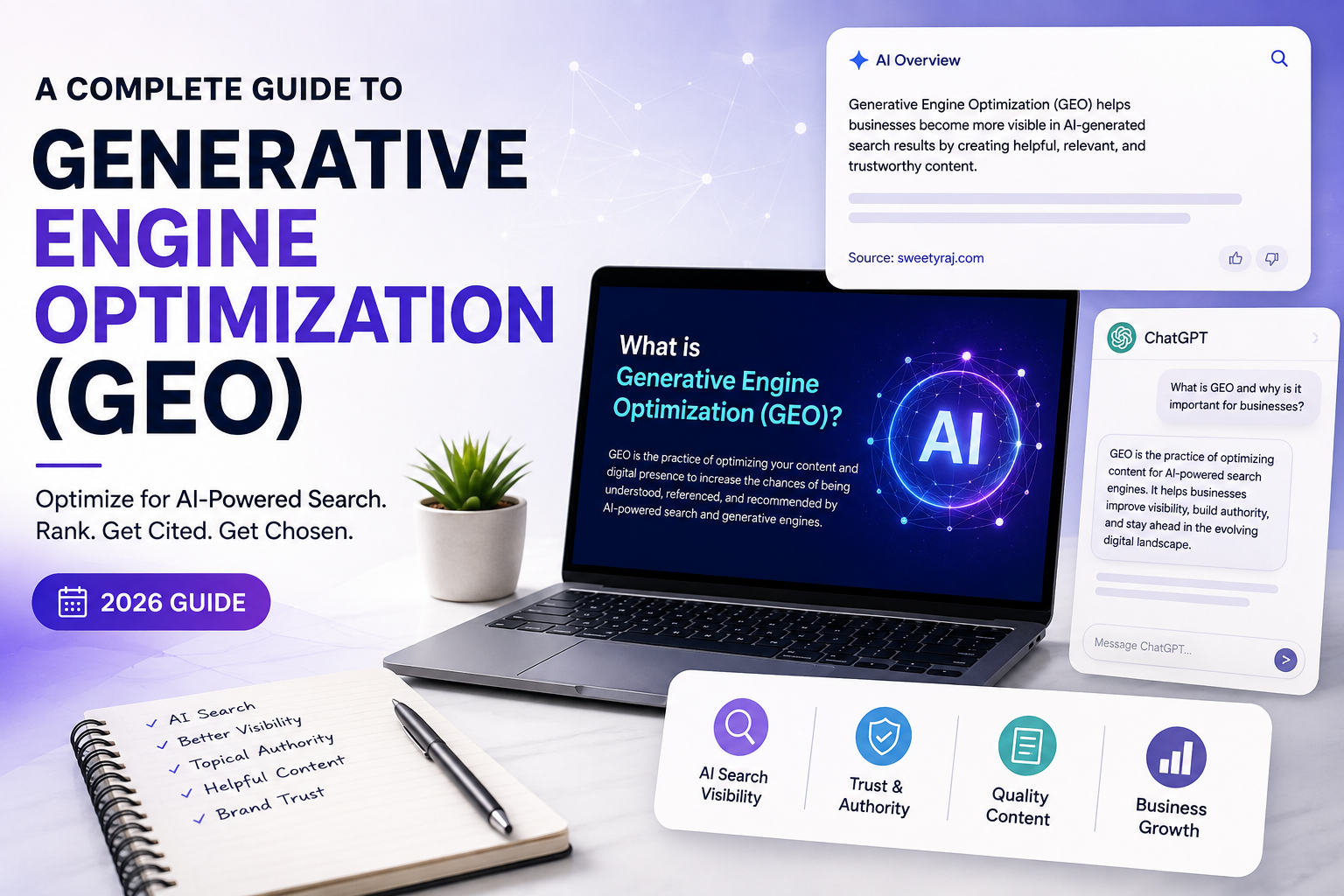
Generative Engine Optimization (GEO) is the practice of creating and optimizing online content so that AI-powered search and answer engines can better understand, retrieve, summarize, and potentially reference that information when answering users’ questions.
Traditional SEO primarily focuses on improving visibility in search engine results pages.
GEO considers another layer:
How can your brand become a useful and trustworthy source when an AI system generates an answer?
For example, imagine someone asks:
“Who is a good AI digital marketing expert for a small business?”
With traditional search, the person might receive a page of search results.
With an AI-powered search experience, the system may provide a conversational answer containing recommendations, explanations, and links to supporting sources.
For a business, being included in that answer can create another opportunity for visibility.
GEO therefore focuses on making your online presence:
- Easy for search engines and AI systems to understand
- Useful and relevant to real questions
- Supported by trustworthy information
- Clearly connected to your business or expertise
- Structured in a way that makes important information easy to identify
- Consistent across your website and other credible online sources
GEO is still an evolving field, so businesses should be careful about anyone promising guaranteed placement in ChatGPT, Google AI Overviews, or other AI platforms.
There is no universal “GEO ranking formula.”
Instead, the best approach is to build a strong digital presence that helps both people and search systems understand what your business does.
Why Is GEO Becoming Important in 2026?
Search behavior is becoming more conversational.
Instead of searching for:
“digital marketing services Chennai”
someone might ask:
“What digital marketing strategy should a small local business use to get more customers?”
The second query contains more context and intent.
AI-powered search experiences are designed to handle these longer, more conversational questions.
Google’s current guidance on AI search emphasizes creating unique, satisfying content and ensuring that websites remain technically accessible and provide a good page experience.
This means businesses have an opportunity to create content that directly answers the questions their customers are asking.
And this is where GEO becomes useful.
GEO vs SEO: What’s the Difference
SEO and GEO are closely connected, but they are not exactly the same.
SEO
Search Engine Optimization focuses on improving a website’s visibility in traditional search engines.
SEO commonly involves:
- Keyword research
- On-page optimization
- Technical SEO
- Internal linking
- Content creation
- Backlink development
- Search intent
- Website performance
- Local SEO
- Search Console monitoring
GEO
Generative Engine Optimization focuses more specifically on visibility within AI-generated answers and generative search experiences.
GEO can involve:
- Creating highly useful informational content
- Answering specific questions clearly
- Building topical authority
- Establishing strong brand and entity information
- Using structured content
- Providing original insights and data
- Creating comparison and explanation content
- Maintaining consistent business information
- Strengthening your overall online presence
The important point is that GEO should not replace SEO.
It should complement it.
Google’s 2026 documentation specifically notes that SEO best practices continue to be relevant to success in generative AI features in Search.
How Does GEO Work?
AI systems need to understand information before they can use it effectively.
Imagine that your website simply says:
“We provide the best digital marketing services.”
That statement provides very little useful context.
Now imagine a website that clearly explains:
- Who the company helps
- What services it provides
- Which industries it serves
- What problems it solves
- How its process works
- What results clients are trying to achieve
- What questions customers frequently ask
- How its services differ from alternatives
The second website gives users—and search systems—much more information to understand.
This is one of the fundamental ideas behind GEO:
Don’t just create content for keywords. Create content that clearly answers real questions.
7 GEO Strategies Businesses Can Use in 2026
1. Create People-First Content
The foundation of a successful GEO strategy is useful content.
Don’t create articles simply because a keyword has search volume.
Instead, ask:
What does my customer actually want to know?
For example, a local restaurant might create:
- How to choose a restaurant for a business meeting
- Best catering options for small events
- How much should business catering cost?
- What should you consider when choosing a catering service?
This type of content can answer genuine customer questions.
Google’s guidance recommends creating content primarily to help people rather than creating content primarily to attract search-engine traffic.
2. Answer Specific Questions
One of the easiest ways to make your content more useful is to answer specific questions.
Instead of writing:
“Digital Marketing Services”
create supporting content such as:
- What is digital marketing?
- How much does digital marketing cost?
- Does SEO work for small businesses?
- How long does SEO take?
- Is Google Ads better than SEO?
- How can a small business generate leads online?
- What is local SEO?
- How does social media marketing generate customers?
These questions reflect real user intent.
You can answer them through blog articles, service pages, FAQs, guides, videos, and other useful content.
Publishing one article about SEO is unlikely to establish strong expertise around the entire subject.
Instead, build a content ecosystem.
For example, if your business provides digital marketing services, you could create content around:
SEO
- SEO basics
- Local SEO
- Technical SEO
- Keyword research
- On-page SEO
- SEO mistakes
Paid Advertising
- Google Ads
- Meta Ads
- Lead generation campaigns
- Conversion tracking
- Remarketing
- Instagram marketing
- Facebook marketing
- LinkedIn marketing
- Content strategy
- Social media advertising
AI Marketing
- AI SEO
- AI content strategy
- GEO
- AI marketing tools
- AI-assisted analytics
This gives your website a broader collection of useful information around your expertise.
4. Create Original Insights
AI systems can generate generic explanations very easily.
That makes generic content less valuable.
Businesses should therefore try to add information that is genuinely useful and difficult to copy.
For example:
- Your own observations
- Original research
- Case studies
- Campaign results
- Screenshots
- Examples
- Data analysis
- Industry comparisons
- Expert opinions
- Step-by-step processes
Instead of simply writing:
“Google Ads can help businesses generate leads.”
you could explain:
“For a local service business, a lead-generation campaign can be structured around high-intent searches, location targeting, conversion tracking, and landing-page optimization.”
The second explanation provides much more practical value.
5. Make Your Website Easy to Understand
Your website should clearly communicate:
Who you are.
What you do.
Who you help.
Where you operate.
Why someone should trust you.
For example, your homepage should not force visitors to guess what your business offers.
A clear website structure might include:
- Home
- About
- Services
- SEO
- Social Media Marketing
- Google Ads
- Website Development
- AI Digital Marketing
- Blog
- Contact
Clear navigation helps users find information quickly.
It also makes your website easier for search engines to understand.
Google’s SEO guidance recommends making content easy to read and well organized, with useful headings and logical structure.
6. Strengthen Your Brand Presence
GEO isn’t only about publishing blog posts.
Your brand should have consistent information across the internet.
Depending on your business, this can include:
- Your website
- Google Business Profile
- Social media profiles
- Business directories
- Industry websites
- Relevant publications
- Client testimonials
- Author profiles
- Portfolio pages
For local businesses, accurate business information is particularly important.
Your business name, services, location, contact information, and website should be consistent wherever possible.
The stronger and clearer your overall digital presence becomes, the easier it is for people—and systems that interpret online information—to understand your business.
7. Don’t Ignore Traditional SEO
One of the biggest GEO mistakes is thinking that SEO is dead.
It isn’t.
Google’s current guidance specifically states that the fundamentals of SEO remain relevant for AI search experiences.
You still need to care about:
- Crawlability
- Indexing
- Page titles
- Headings
- Internal links
- Relevant content
- Website structure
- Mobile usability
- Page experience
- Search intent
- Technical SEO
Google’s Search Essentials also explains that technical requirements, spam policies, and key best practices remain fundamental to appearing and performing in Google Search.
Think of it this way:
SEO helps your content become discoverable and understandable.
GEO adds another layer focused on how your content and brand can be surfaced in generative experiences.
What Types of Content Work Well for GEO?
There isn’t one magic content format that guarantees AI visibility.
However, businesses can focus on formats that provide clear, useful information.
1. Detailed Guides
Example:
“The Complete Guide to Local SEO for Small Businesses”
2. Comparisons
Example:
“SEO vs Google Ads: Which Is Better for Small Businesses?”
3. FAQs
Example:
“How Much Does Digital Marketing Cost for a Small Business?”
4. Step-by-Step Tutorials
Example:
“How to Set Up Google Analytics Conversion Tracking”
5. Original Research
Example:
“Digital Marketing Trends Among Small Businesses in 2026”
6. Case Studies
Example:
“How a Local Business Increased Qualified Leads Through Search Marketing”
7. Definitions and Explainers
Example:
“What Is Generative Engine Optimization?”
The goal is not simply to produce more content.
The goal is to produce better content that solves real problems.
How AI Can Help With GEO
AI tools can be useful during the content creation process.
For example, AI can help marketers:
- Brainstorm topics
- Identify potential questions
- Organize article structures
- Analyze large amounts of information
- Generate content outlines
- Improve readability
- Summarize research
- Find content gaps
- Create variations of headlines
- Assist with data analysis
But there is an important distinction:
AI should assist your marketing process, not replace expertise and originality.
Google’s guidance says generative AI can be useful for researching topics and adding structure to original content, but generating large numbers of pages without adding value can violate its spam policies.
So don’t publish hundreds of generic AI-written articles just to target keywords.
Use AI to work smarter, then add your own knowledge, experience, examples, research, and perspective.
Common GEO Mistakes to Avoid
Mistake 1: Keyword Stuffing
Repeating a keyword dozens of times doesn’t make an article better.
Write naturally and cover the topic comprehensively.
Google’s systems can understand relationships between concepts and variations of search queries, so forcing exact-match keywords everywhere isn’t necessary.
Mistake 2: Publishing Generic AI Content
If your article says the same thing as hundreds of other websites, it doesn’t give readers a strong reason to choose you.
Add original examples, insights, data, experience, and practical advice.
Mistake 3: Writing Only for Search Engines
Your customer should always come first.
Ask:
Would this article still be useful if Google didn’t exist?
If the answer is yes, you’re probably moving in the right direction.
Mistake 4: Ignoring Your Website
Great content cannot compensate for a confusing website.
Make sure your website is:
- Fast
- Mobile-friendly
- Easy to navigate
- Secure
- Well structured
- Easy to contact
- Clear about your services
Google’s AI-search guidance also highlights the importance of page experience and making content technically accessible to Search.
Mistake 5: Expecting Instant Results
GEO is not a shortcut to overnight visibility.
Building authority takes time.
Your strategy should focus on consistently creating useful content, improving your website, strengthening your brand presence, and measuring what works.
GEO for Small Businesses
You don’t need a huge marketing budget to start.
A small business can begin with a simple GEO strategy.
Step 1: Identify customer questions
Talk to customers and identify the questions they repeatedly ask.
Step 2: Turn questions into content
Create blog posts, service pages, FAQs, videos, and guides around those questions.
Step 3: Improve existing pages
Make your service pages more detailed and useful.
Step 4: Build local visibility
Keep your Google Business Profile and other business information accurate and consistent.
Step 5: Create helpful supporting content
Don’t only talk about your products.
Teach your audience how to solve problems.
Step 6: Track results
Monitor:
- Organic traffic
- Search impressions
- Clicks
- Leads
- Calls
- Form submissions
- Engagement
- Branded searches
- Conversions
Google also recommends evaluating the broader value of search visits rather than focusing only on clicks, including conversions and other meaningful outcomes.
Does GEO Replace SEO?
No.
This is one of the most important things businesses need to understand.
SEO and GEO should work together.
Think of your digital strategy as a foundation:
Technical SEO → Content → Authority → Brand → AI Search Visibility
If your website cannot be crawled, your content is poor, or your business information is unclear, adding “GEO tactics” won’t magically solve the problem.
Strong fundamentals come first.
Then you can build content and brand authority that works across traditional search and emerging AI-powered search experiences.
How to Create a GEO-Friendly Blog Post
Before publishing your next article, use this simple framework:
1. Start with the user’s question
Know exactly what problem your article solves.
2. Give a direct answer
Don’t make readers wait through five paragraphs before reaching the answer.
3. Explain the topic clearly
Use simple language and meaningful examples.
4. Break the article into sections
Use H2 and H3 headings.
Answer the questions people are likely to ask next.
6. Add original value
Include examples, data, experiences, opinions, or research.
7. Link to relevant pages
Use internal links to connect your blog with your service pages and other useful articles.
8. Add relevant visuals
Use helpful images, screenshots, charts, or videos when they improve understanding.
9. Optimize the technical elements
Review the page title, meta description, URL, headings, images, links, and indexing.
10. Update the article
Digital marketing changes quickly.
Review important articles periodically and update outdated information.
The Future of Digital Marketing Is More Than Ranking
Digital marketing is moving from a simple question:
“Where does my website rank?”
toward a broader question:
“Can customers discover, understand, trust, and choose my business across search and AI-powered experiences?”
That is a much bigger challenge.
Businesses need strong websites, useful content, recognizable brands, trustworthy information, and strategies that adapt as search behavior changes.
GEO is part of that evolution.
But it shouldn’t be treated as a replacement for everything marketers already know.
The strongest approach is to combine:
SEO + Content Marketing + Local SEO + Social Media + Paid Advertising + Brand Building + AI Optimization
When these areas work together, businesses can create a digital presence that is designed not only to attract visitors, but to turn those visitors into customers.
Final Thoughts
Generative Engine Optimization is becoming an important concept as people increasingly use AI-powered experiences to discover information and make decisions.
But GEO isn’t about finding a secret trick that forces an AI system to mention your business.
It’s about becoming genuinely useful.
Create content that answers real questions.
Build a website that clearly explains what you offer.
Demonstrate your expertise.
Provide original information.
Keep your business details accurate.
Follow strong SEO fundamentals.
And use AI as a tool to improve your marketing—not as a substitute for human expertise.
Google’s current guidance makes this direction clear: unique, useful, people-first content and solid technical foundations remain important even as AI changes the way search works.
For businesses willing to adapt, this change isn’t just a challenge.
It’s an opportunity to become more visible, more useful, and more trusted wherever your customers are searching.
Frequently Asked Questions About GEO
What is Generative Engine Optimization?
Generative Engine Optimization (GEO) is the practice of improving a brand’s online content and digital presence so AI-powered search and answer systems can better understand and potentially surface or reference that information in generated responses.
Is GEO the same as SEO?
No. GEO and SEO overlap, but they have different focuses. SEO primarily targets visibility in traditional search results, while GEO focuses on visibility and representation within generative AI search experiences. Strong SEO fundamentals remain important for both.
Does GEO replace SEO?
No. GEO should complement SEO rather than replace it. Technical SEO, useful content, website structure, search intent, and accessibility remain important foundations.
Can AI-generated content rank on Google?
AI-generated content isn’t automatically disqualified from Google Search. However, Google emphasizes that content should provide value to users and warns against using automation to generate large amounts of low-value content primarily to manipulate rankings.
How can a small business start with GEO?
Start by identifying the questions your customers ask, creating genuinely useful content around those questions, improving your service pages, strengthening your local online presence, and maintaining strong SEO fundamentals.
How long does GEO take to work?
There is no fixed timeline or guaranteed result. Visibility depends on factors such as your website, competition, content quality, authority, industry, and the AI/search system involved. GEO should be treated as a long-term digital marketing strategy.
Why is GEO important in 2026?
Search is becoming increasingly conversational and AI-assisted. As users discover information through generative search experiences, businesses have another opportunity to be discovered through useful, authoritative content.
Should businesses hire a GEO expert?
Businesses that don’t have the time or expertise to manage SEO, content, AI search optimization, and digital strategy may benefit from working with a digital marketing professional who understands both traditional search and emerging AI search experiences.
About Sweetyraj
Sweetyraj helps small businesses, startups, and growing brands build a stronger digital presence through practical digital marketing strategies.
From SEO and social media marketing to paid advertising and website development, the focus is on creating strategies that are designed around real business goals—not simply generating traffic.
As AI continues to change the way people search and discover businesses, staying adaptable is becoming more important than ever.
Want to improve your business’s online visibility? Explore the digital marketing services offered by Sweetyraj and start building a stronger digital presence today.