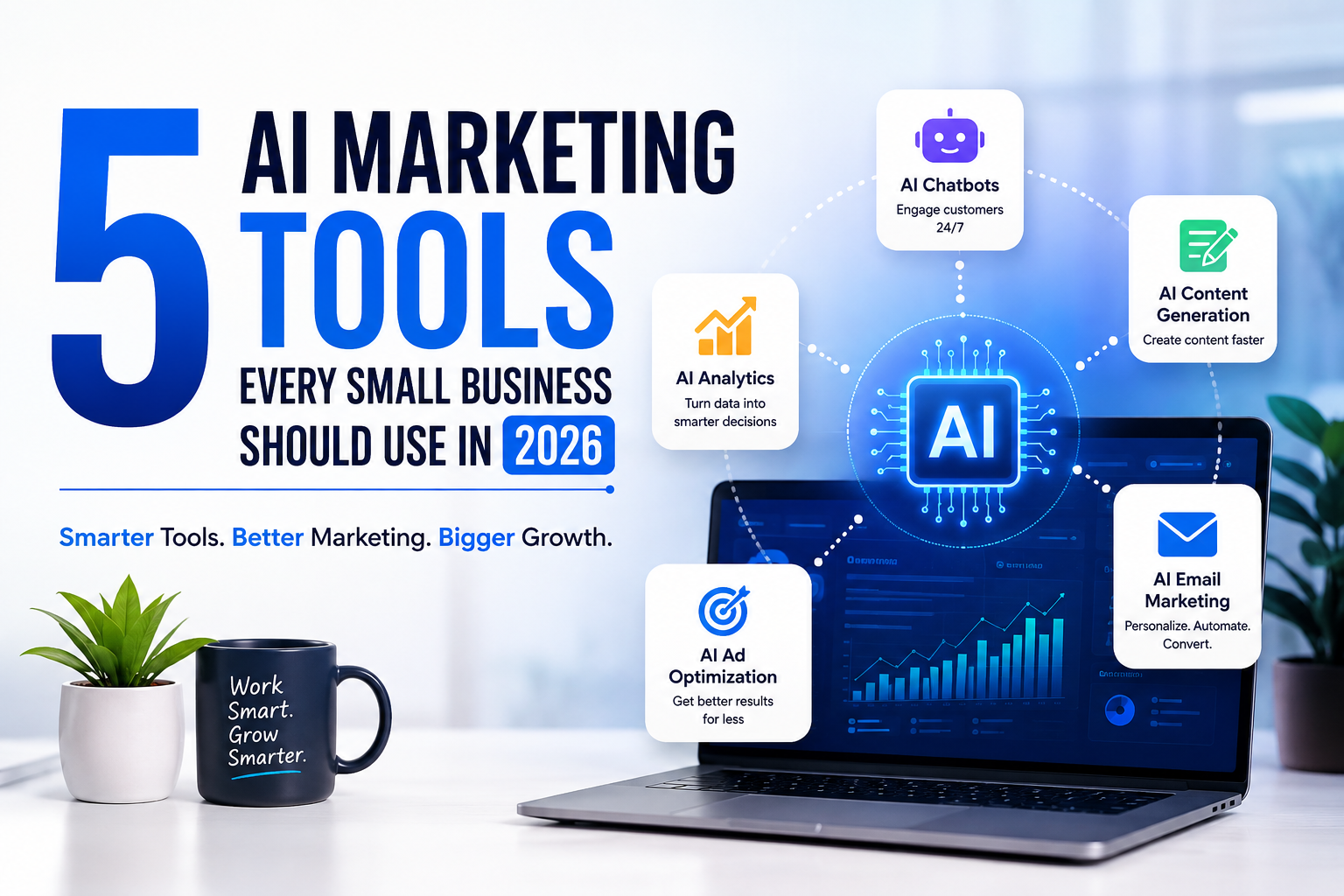
5 AI Marketing Tools Every Small Business Should Use in 2026
Introduction
Running a small business means wearing many hats. One day you’re creating social media posts, the next you’re answering customer emails, researching keywords, managing ads, and checking website performance.
The good news? AI is changing the way small businesses approach digital marketing.
In 2026, AI marketing tools can help businesses automate repetitive tasks, create content faster, understand customers, improve SEO, and make better marketing decisions without needing a large marketing team.
Google itself highlights AI as a way for small businesses to work more efficiently and operate with capabilities that were traditionally associated with larger brands.
But with hundreds of AI tools available, where should a small business start?
Here are five AI marketing tools worth considering in 2026.
1. ChatGPT – Your AI Marketing Assistant
One of the most versatile AI tools for marketing is ChatGPT.
For a small business, ChatGPT can act as a marketing assistant, content writer, brainstorming partner, research assistant, and campaign planning tool.
Instead of starting every marketing task from scratch, you can use AI to create a first draft and then add your business’s expertise and personality.
What can you use it for?
You can use ChatGPT to:
- Generate blog ideas
- Create social media captions
- Write email campaigns
- Create ad copy
- Develop content calendars
- Brainstorm marketing campaigns
- Create customer personas
- Rewrite website copy
- Generate video scripts
- Create SEO content outlines
- Develop FAQs
- Brainstorm calls-to-action
For example, instead of spending an hour thinking about social media ideas, a small business owner can provide information about their product, audience, and goals and ask AI to generate a month’s worth of content ideas.
Why small businesses should use it
The biggest advantage is speed.
AI doesn’t replace your brand’s knowledge. Instead, it helps you move from a blank page to a useful first draft much faster.
The best approach is to use AI for ideas and execution while keeping human review, brand voice, accuracy, and originality at the center.
2. Canva – AI-Powered Content and Design
Visual content is essential for modern digital marketing, but many small businesses don’t have an in-house designer.
That’s where Canva can help.
Canva’s Magic Studio brings multiple AI-powered design capabilities into one platform, including tools designed to speed up content creation, transform existing designs, and create marketing materials without requiring advanced design skills.
What can you create?
Small businesses can use Canva to create:
- Instagram posts
- Facebook ads
- YouTube thumbnails
- Blog graphics
- Presentations
- Flyers
- Posters
- Business banners
- Product visuals
- Social media carousels
- Marketing presentations
One particularly useful concept is content repurposing.
For example, you could take a blog post and turn its key ideas into social media graphics, presentation slides, or other marketing formats.
This makes it easier for a small business to maintain a consistent presence across multiple channels.
Why Canva is useful for small businesses
Professional design can be expensive and time-consuming.
AI-powered design tools allow business owners and marketers to produce better-looking content faster while maintaining brand consistency.
3. Semrush – AI-Powered SEO and Search Visibility
Getting found online is one of the biggest challenges for small businesses.
You may have an excellent product or service, but if potential customers can’t find your website, you’re missing opportunities.
Semrush provides tools for keyword research, competitor analysis, technical SEO, content optimization, and AI visibility. Its current platform also includes tools for monitoring how brands appear in AI-generated search experiences.
What can you use Semrush for?
A small business can use it to:
- Find relevant keywords
- Analyze competitors
- Discover content opportunities
- Audit website SEO
- Track keyword rankings
- Identify technical SEO problems
- Analyze backlinks
- Monitor AI search visibility
- Find topics customers are searching for
For example, imagine you run a local digital marketing agency.
Instead of guessing what potential customers search for, you can research terms such as:
“digital marketing agency near me”
“Google Ads agency for small business”
“SEO services for small businesses”
You can then create useful content around topics that match real search demand.
Why SEO tools matter in 2026
Search is changing.
People increasingly discover businesses through traditional search engines as well as AI-powered search experiences.
That means businesses need to think beyond simply ranking for keywords. They also need to create useful, trustworthy, well-structured content that can be understood and referenced across modern search experiences.
4. HubSpot Breeze – AI for Marketing and Customer Management
Marketing isn’t just about attracting visitors.
You also need to manage leads, communicate with customers, and move prospects through the buying journey.
HubSpot’s Breeze is its AI platform that supports tasks such as content creation, information retrieval, workflow automation, and other marketing and customer-facing activities.
HubSpot’s marketing platform also focuses on attracting, converting, and engaging high-intent visitors while supporting cross-channel campaigns.
What can it help with?
Depending on the plan and features available, businesses can use HubSpot’s AI capabilities for:
- Content creation
- Lead management
- Marketing automation
- Customer communication
- CRM workflows
- Campaign management
- Reporting
- Lead nurturing
- Personalization
Why this matters
Imagine receiving 50 leads in a month.
Without automation, following up with every lead manually can become difficult.
With a CRM and automation system, businesses can organize leads, trigger follow-ups, track interactions, and spend more time talking to high-value prospects.
For a growing small business, this can make marketing much more organized.
5. Mailchimp – AI-Powered Email Marketing
Email marketing remains one of the most useful channels for businesses that want to build long-term customer relationships.
Mailchimp now includes AI-powered capabilities for content creation, personalization, campaign automation, analytics, and optimization.
What can small businesses use it for?
You can use AI-powered email marketing tools to:
- Create email content
- Write subject lines
- Build automated campaigns
- Welcome new subscribers
- Re-engage inactive customers
- Personalize messages
- Recommend send times
- Test different content
- Analyze campaign performance
For example, instead of manually sending the same email to every customer, you can create automated customer journeys based on actions such as signing up, making a purchase, or becoming inactive.
Mailchimp also provides AI-assisted recommendations around campaign timing and content optimization.
Why email automation is valuable
A small business doesn’t need to manually communicate with every customer.
Automation allows you to create a system that continues working in the background while you focus on other areas of the business.
How to Choose the Right AI Marketing Tool
You don’t need to subscribe to every AI tool available.
In fact, using too many platforms can create unnecessary complexity.
Instead, identify your biggest marketing problem first.
If you need help creating content:
ChatGPT
If you need better visual content:
Canva
If you want more organic traffic:
Semrush
If you need CRM and marketing automation:
HubSpot
If you want to improve email marketing:
Mailchimp
The right combination depends on your business size, budget, marketing goals, and existing technology.
How Small Businesses Can Use AI Without Losing the Human Touch
AI can produce content quickly, but faster doesn’t always mean better.
Your customers still want authentic communication.
That’s why the best approach is:
AI + Human Expertise = Better Marketing
Use AI for:
- Research
- Brainstorming
- First drafts
- Repetitive tasks
- Data analysis
- Automation
- Personalization
Use humans for:
- Strategy
- Brand positioning
- Creativity
- Fact-checking
- Customer relationships
- Final decisions
Don’t simply publish everything AI generates.
Review it, improve it, add your experience, and make sure it sounds like your brand.
Final Thoughts
AI marketing tools are no longer just experimental technology.
For small businesses, they can become practical tools for saving time, improving productivity, creating better content, and making more informed marketing decisions.
The goal isn’t to replace your marketing team with AI.
The goal is to give a small team the capabilities of a much larger one.
Start with one problem. Choose one tool. Learn how to use it properly. Measure the results. Then expand.
In 2026, the businesses that win won’t necessarily be the ones using the most AI tools.
They’ll be the ones using the right AI tools in the right way.
Frequently Asked Questions
What are AI marketing tools?
AI marketing tools are software platforms that use artificial intelligence to help businesses with tasks such as content creation, SEO, advertising, customer communication, analytics, personalization, and marketing automation.
What is the best AI marketing tool for small businesses?
There isn’t one tool that is best for every business. ChatGPT is useful for general marketing tasks, Canva is useful for visual content, Semrush is useful for SEO, HubSpot is useful for CRM and automation, and Mailchimp is useful for email marketing.
Can AI replace digital marketers?
AI can automate many repetitive marketing tasks, but it doesn’t completely replace digital marketers. Strategy, creativity, brand understanding, critical thinking, and customer relationships still require human input.
Are AI marketing tools expensive?
Many AI marketing platforms offer free plans, trials, or entry-level options, while advanced features may require paid subscriptions. Small businesses should choose tools based on their actual needs and expected return on investment.
How should a small business start using AI marketing?
Start with one repetitive or time-consuming marketing task. For example, use AI to create content ideas, automate email follow-ups, analyze SEO opportunities, or produce social media designs. Measure the results before adding more tools.
Ready to make your marketing smarter? Start with one AI tool, build a simple workflow, and scale what works.
[/et_pb_text][/et_pb_column] [/et_pb_row] [/et_pb_section]